2026 · conference
Skin-Deep: A Geometric Diagnostic for Alignment Fragility in Large Language Model Representations
Dongyub Jude Lee, Jungseob Lee, Seungyoon Lee, Seongtae Hong, Suhyune Son, Sugyeong Eo, Jaehyung Seo, Heuiseok Lim†
Findings of the Association for Computational Linguistics: AACL-IJCNLP 2026
Abstract
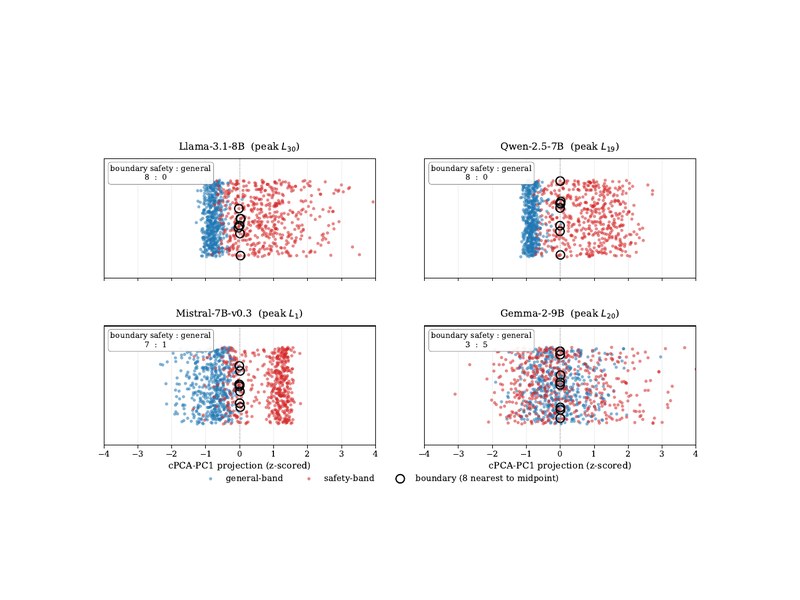
Alignment tuning is meant to make harmful-request refusal robust, yet this safety behavior can be erased by a small set of benign fine-tuning examples. This is a deployment risk for open-weight models because a checkpoint can pass refusal tests at release time and later lose refusal under low-cost downstream fine-tuning. Prior work has established these refusal failures, but existing studies do not show how to detect this fragility in the aligned model itself before an attack or fine-tuning intervention is run. We introduce Skin-Deep, a geometric diagnostic that detects alignment fragility directly from the aligned model's hidden-state activations before such an intervention is run and compresses the layer-wise safety geometry into a single scalar, the Geometric Fragility Score (GFS). Applied to twenty-one instruction-tuned models spanning six alignment recipes and 3B--32B parameters, Skin-Deep reveals a recurring low-rank safety subspace across model families. Direction ablations show that removing directions in this subspace weakens harmful-request refusal, providing causal evidence that the recovered geometry underlies refusal behavior. Crucially, GFS identifies, before any fine-tuning, the initially safe model that retains the most refusal after small-scale LoRA fine-tuning. These results establish GFS as a practical pre-deployment diagnostic for flagging fragile refusal behavior without running an attack.
Motivation
<!-- Replace the sentence below with your personal motivation for this work. -->Personal motivation for this work will be added here.
Notes
<!-- Optional: add contributions, behind-the-scenes notes, talks, code, or media links. -->BibTeX
@inproceedings{2026-skin-deep-geometric-diagnostic-alignment-fragility,
  title = {Skin-Deep: A Geometric Diagnostic for Alignment Fragility in Large Language Model Representations},
  author = {Dongyub Jude Lee and Jungseob Lee and Seungyoon Lee and Seongtae Hong and Suhyune Son and Sugyeong Eo and Jaehyung Seo and Heuiseok Lim},
  booktitle = {Findings of the Association for Computational Linguistics: AACL-IJCNLP 2026},
  year = {2026},
  month = {11},
  abstract = {Alignment tuning is meant to make harmful-request refusal robust, yet this safety behavior can be erased by a small set of benign fine-tuning examples. This is a deployment risk for open-weight models because a checkpoint can pass refusal tests at release time and later lose refusal under low-cost downstream fine-tuning. Prior work has established these refusal failures, but existing studies do not show how to detect this fragility in the aligned model itself before an attack or fine-tuning intervention is run. We introduce Skin-Deep, a geometric diagnostic that detects alignment fragility directly from the aligned model's hidden-state activations before such an intervention is run and compresses the layer-wise safety geometry into a single scalar, the Geometric Fragility Score (GFS). Applied to twenty-one instruction-tuned models spanning six alignment recipes and 3B--32B parameters, Skin-Deep reveals a recurring low-rank safety subspace across model families. Direction ablations show that removing directions in this subspace weakens harmful-request refusal, providing causal evidence that the recovered geometry underlies refusal behavior. Crucially, GFS identifies, before any fine-tuning, the initially safe model that retains the most refusal after small-scale LoRA fine-tuning. These results establish GFS as a practical pre-deployment diagnostic for flagging fragile refusal behavior without running an attack.},
  url = {https://arxiv.org/abs/2606.22676}
}