2026 · conference
SHIFT: Semantic Harmonization via Index-side Feature Transformation for Multilingual Information Retrieval
Youngjoon Jang, Seongtae Hong, Hyeonseok Moon, Heuiseok Lim†
Findings of the Association for Computational Linguistics: EMNLP 2026
Abstract
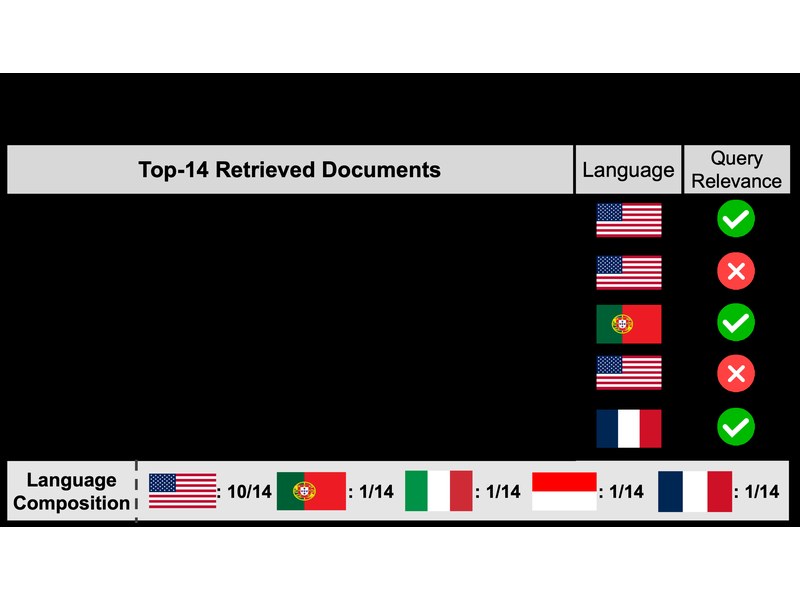
With the rapid expansion of massive multilingual corpora, Multilingual Information Retrieval (MLIR) has emerged as a critical technology for global information access. MLIR enables users to retrieve semantically relevant documents from multilingual text collections using a single-language query. However, recent multilingual dense retrieval models often exhibit a strong preference for documents in the same language as the query. This leads to severe language bias, where top-ranked results are dominated by documents of specific languages, even when documents in other languages contain more semantically relevant information. To address this issue, we propose SHIFT, a training-free method applicable in the indexing stage. Specifically, SHIFT utilizes parallel translation pairs to estimate a relative language vector for each target language with respect to a source language. Subsequently, SHIFT corrects the language-specific offset by subtracting this relative language vector from document embeddings during indexing. Our comprehensive evaluation across four MLIR benchmarks and diverse dense retrieval models confirms that SHIFT can effectively mitigate language bias and enhance MLIR performance.
Motivation
<!-- Replace the sentence below with your personal motivation for this work. -->Personal motivation for this work will be added here.
Notes
<!-- Optional: add contributions, behind-the-scenes notes, talks, code, or media links. -->BibTeX
@inproceedings{2026-shift-semantic-harmonization-index-side-feature,
  title = {SHIFT: Semantic Harmonization via Index-side Feature Transformation for Multilingual Information Retrieval},
  author = {Youngjoon Jang and Seongtae Hong and Hyeonseok Moon and Heuiseok Lim},
  booktitle = {Findings of the Association for Computational Linguistics: EMNLP 2026},
  year = {2026},
  month = {10},
  abstract = {With the rapid expansion of massive multilingual corpora, Multilingual Information Retrieval (MLIR) has emerged as a critical technology for global information access. MLIR enables users to retrieve semantically relevant documents from multilingual text collections using a single-language query. However, recent multilingual dense retrieval models often exhibit a strong preference for documents in the same language as the query. This leads to severe language bias, where top-ranked results are dominated by documents of specific languages, even when documents in other languages contain more semantically relevant information. To address this issue, we propose SHIFT, a training-free method applicable in the indexing stage. Specifically, SHIFT utilizes parallel translation pairs to estimate a relative language vector for each target language with respect to a source language. Subsequently, SHIFT corrects the language-specific offset by subtracting this relative language vector from document embeddings during indexing. Our comprehensive evaluation across four MLIR benchmarks and diverse dense retrieval models confirms that SHIFT can effectively mitigate language bias and enhance MLIR performance.},
  url = {https://arxiv.org/abs/2606.18801}
}