2026 · conference
SemBridge: Language Transfer in Sparse Encoders via Multilingual Semantic Bridges
Seongtae Hong, Youngjoon Jang, Jia-Heui Ju, Hyeonseok Moon, Heuiseok Lim†
Proceedings of the 2026 Conference on Empirical Methods in Natural Language Processing
Abstract
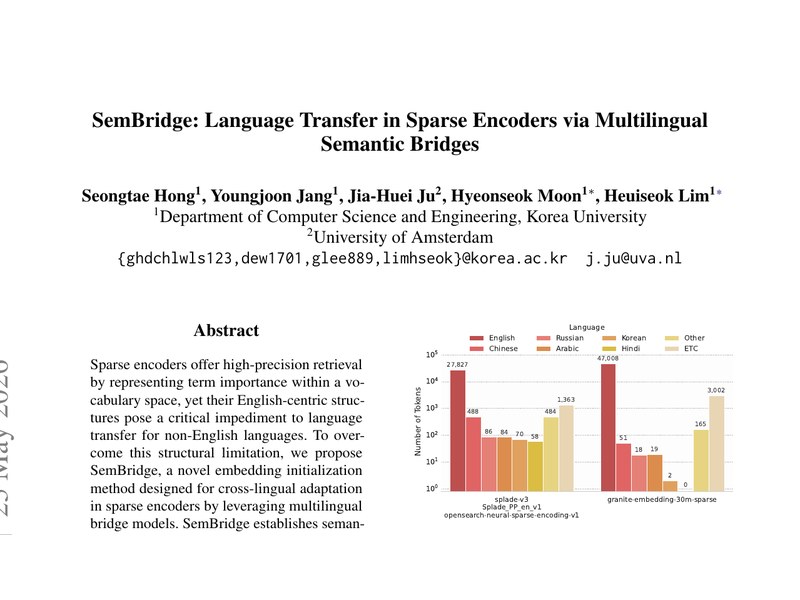
Sparse encoders offer high-precision retrieval by representing term importance within a vocabulary space, yet their English-centric structures pose a critical impediment to language transfer for non-English languages. To overcome this structural limitation, we propose SemBridge, a novel embedding initialization method designed for cross-lingual adaptation in sparse encoders by leveraging multilingual bridge models. SemBridge establishes semantic alignments between source and target vocabularies using multilingual dense embeddings as a bridge. Rather than directly relying on all source tokens, SemBridge selects a small set of semantically related source-language tokens and uses them to initialize each target-language token, effectively filtering out semantic noise and reconstructing target tokens as precise linear combinations of core synonyms. This accelerates convergence during fine-tuning and improves training efficiency. Extensive experiments across five languages and four sparse architectures demonstrate that SemBridge achieves superior zero-shot retrieval performance and consistently improves retrieval performance after fine-tuning compared to existing baselines. These results validate SemBridge as a practical solution for deploying high-performance sparse retrieval systems in diverse linguistic environments.
Motivation
<!-- Replace the sentence below with your personal motivation for this work. -->Personal motivation for this work will be added here.
Notes
<!-- Optional: add contributions, behind-the-scenes notes, talks, code, or media links. -->BibTeX
@inproceedings{2026-sembridge-language-transfer-sparse-encoders-multilingual,
  title = {SemBridge: Language Transfer in Sparse Encoders via Multilingual Semantic Bridges},
  author = {Seongtae Hong and Youngjoon Jang and Jia-Heui Ju and Hyeonseok Moon and Heuiseok Lim},
  booktitle = {Proceedings of the 2026 Conference on Empirical Methods in Natural Language Processing},
  year = {2026},
  month = {10},
  abstract = {Sparse encoders offer high-precision retrieval by representing term importance within a vocabulary space, yet their English-centric structures pose a critical impediment to language transfer for non-English languages. To overcome this structural limitation, we propose SemBridge, a novel embedding initialization method designed for cross-lingual adaptation in sparse encoders by leveraging multilingual bridge models. SemBridge establishes semantic alignments between source and target vocabularies using multilingual dense embeddings as a bridge. Rather than directly relying on all source tokens, SemBridge selects a small set of semantically related source-language tokens and uses them to initialize each target-language token, effectively filtering out semantic noise and reconstructing target tokens as precise linear combinations of core synonyms. This accelerates convergence during fine-tuning and improves training efficiency. Extensive experiments across five languages and four sparse architectures demonstrate that SemBridge achieves superior zero-shot retrieval performance and consistently improves retrieval performance after fine-tuning compared to existing baselines. These results validate SemBridge as a practical solution for deploying high-performance sparse retrieval systems in diverse linguistic environments.},
  url = {https://arxiv.org/abs/2605.26002}
}