2026 · journal
Rescaling MLM-Head for Neural Sparse Retrieval
Youngjoon Jang, Seongtae Hong, Jonah Turner, Heuiseok Lim†
arXiv preprint arXiv:2606.18811
Abstract
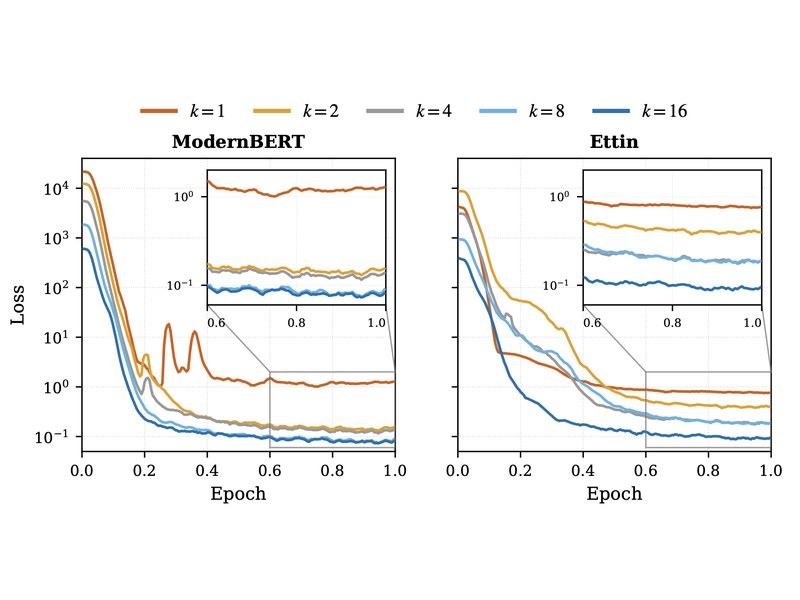
Learned sparse retrieval (LSR) models such as SPLADE have traditionally used BERT-style masked language models as backbone encoders. A natural expectation is that replacing BERT with stronger pretrained encoders should improve retrieval effectiveness. However, we find that under standard SPLADE training recipes, backbones with large MLM-head L2 norms can suffer performance degradation and even training collapse under standard SPLADE training recipes. We identify this failure as a scale mismatch in the MLM head: SPLADE directly uses MLM-head outputs to construct sparse lexical representations, and query-document relevance is computed by an unnormalized dot product over these representations. As a result, an inflated MLM-head scale can amplify sparse activations, distort matching scores, and destabilize contrastive training under common training settings. To address this issue, we introduce a simple initialization-time correction that rescales the MLM-head projection by a constant factor before SPLADE training. This zero-cost adjustment improves training stability without modifying the model architecture or training objective. Across both in-domain and out-of-domain retrieval benchmarks, this simple correction substantially improves large-norm backbones such as ModernBERT and Ettin, turning unstable training runs into competitive sparse retrievers. In several settings, the corrected models further match or surpass the classic BERT-SPLADE baseline. These findings suggest that the bottleneck in adapting pretrained encoders to LSR is not encoder capacity alone, but the calibration of the MLM-head scale used to …
Motivation
<!-- Replace the sentence below with your personal motivation for this work. -->Personal motivation for this work will be added here.
Notes
<!-- Optional: add contributions, behind-the-scenes notes, talks, code, or media links. -->BibTeX
@article{2026-rescaling-mlm-head-neural-sparse-retrieval,
  title = {Rescaling MLM-Head for Neural Sparse Retrieval},
  author = {Youngjoon Jang and Seongtae Hong and Jonah Turner and Heuiseok Lim},
  journal = {arXiv preprint arXiv:2606.18811},
  year = {2026},
  month = {6},
  abstract = {Learned sparse retrieval (LSR) models such as SPLADE have traditionally used BERT-style masked language models as backbone encoders. A natural expectation is that replacing BERT with stronger pretrained encoders should improve retrieval effectiveness. However, we find that under standard SPLADE training recipes, backbones with large MLM-head L2 norms can suffer performance degradation and even training collapse under standard SPLADE training recipes. We identify this failure as a scale mismatch in the MLM head: SPLADE directly uses MLM-head outputs to construct sparse lexical representations, and query-document relevance is computed by an unnormalized dot product over these representations. As a result, an inflated MLM-head scale can amplify sparse activations, distort matching scores, and destabilize contrastive training under common training settings. To address this issue, we introduce a simple initialization-time correction that rescales the MLM-head projection by a constant factor before SPLADE training. This zero-cost adjustment improves training stability without modifying the model architecture or training objective. Across both in-domain and out-of-domain retrieval benchmarks, this simple correction substantially improves large-norm backbones such as ModernBERT and Ettin, turning unstable training runs into competitive sparse retrievers. In several settings, the corrected models further match or surpass the classic BERT-SPLADE baseline. These findings suggest that the bottleneck in adapting pretrained encoders to LSR is not encoder capacity alone, but the calibration of the MLM-head scale used to …},
  url = {https://arxiv.org/abs/2606.18811}
}