2026 · journal
Refusal Localizes, the Damage Relocates: Safety Layers Under Few-Sample Fine-Tuning
Jungseob Lee, Dongyub Jude Lee, Sugyeong Eo, Seongtae Hong, Seungyoon Lee, Heuiseok Lim†
arXiv preprint arXiv:2610.00320
Abstract
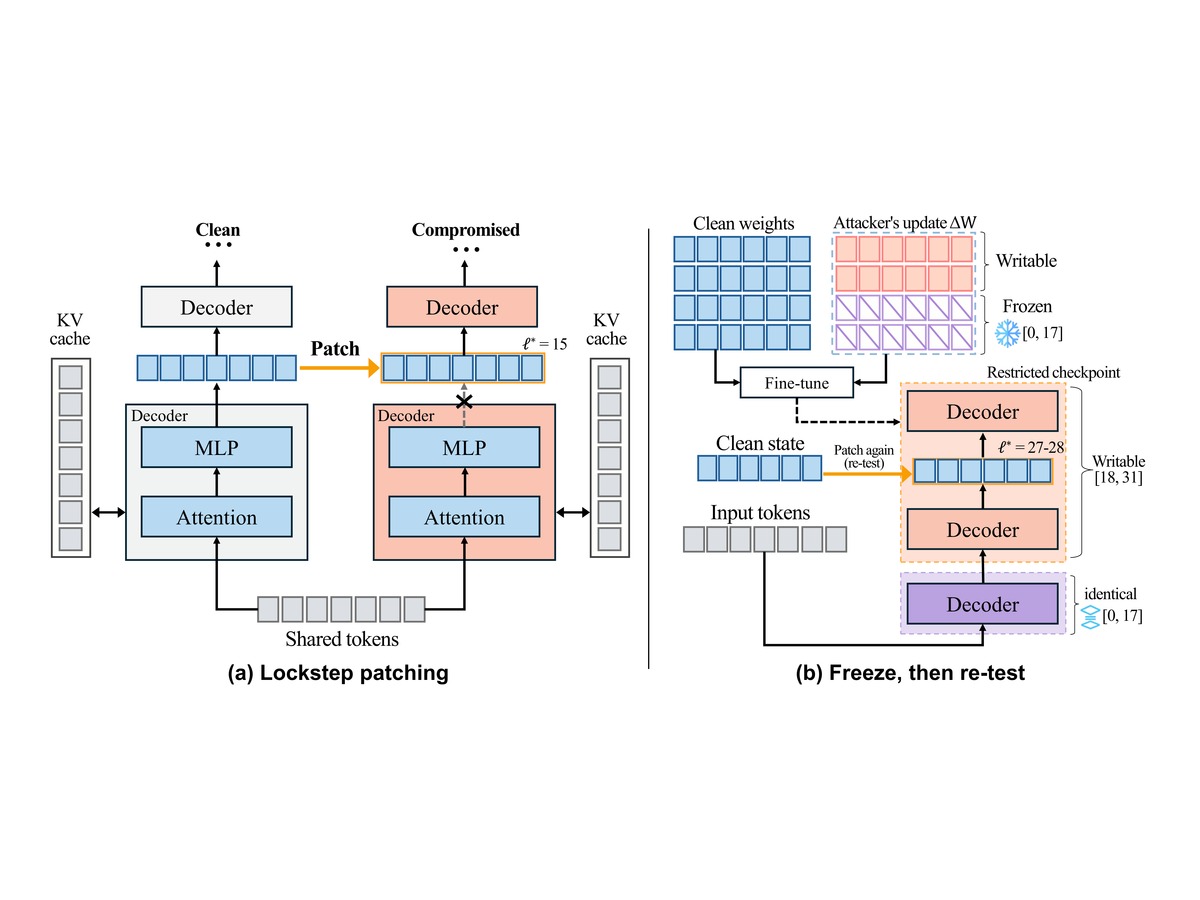
Fine-tuning adapts aligned large language models (LLMs) to downstream tasks, but a few dozen harmful examples can remove their refusal of harmful requests. Prior work localizes safety-related behavior to specific layers, directions, and tokens, suggesting targets for protection. We test whether successful localization and recovery support defenses that survive changes in the attack. Across six checkpoints from four model families, harmful and benign prompts remain linearly separable after attack, and patching full clean hidden states into the compromised model restores refusal at a reproducible transition depth. Building on a prior layer-freezing defense, we freeze every layer up to this depth and repeat the attack. At a hundred harmful examples, refusal remains near zero on all six checkpoints, with recovery transitions above the frozen boundary. In a second study, removing the update's top two singular directions restores refusal after short attention-only fine-tunes on four checkpoints. On Llama-3.1-8B, ordinary training changes weaken this repair and an attacker who spreads the update defeats it. A spectral detector calibrated on benign Llama fine-tunes misses most repair failures on that checkpoint. Localized freezing can nevertheless help preserve refusal when a few harmful examples enter training data unintentionally. These results show that an attacker can bypass a region identified by recovery and defeat a repair that works across multiple checkpoints, motivating five checks for defenses against adaptive fine-tuning. Code is available at https://github.com/js-lee-AI/refusal-relocates.
Motivation
This work asks whether safety mechanisms that appear localized inside a language model remain protective once an attacker adapts the fine-tuning strategy, with the goal of making safety defenses more realistic and durable.
Resources
BibTeX
@article{2026-refusal-localizes-damage-relocates-safety-layers,
  title = {Refusal Localizes, the Damage Relocates: Safety Layers Under Few-Sample Fine-Tuning},
  author = {Jungseob Lee and Dongyub Jude Lee and Sugyeong Eo and Seongtae Hong and Seungyoon Lee and Heuiseok Lim},
  journal = {arXiv preprint arXiv:2610.00320},
  year = {2026},
  month = {10},
  abstract = {Fine-tuning adapts aligned large language models (LLMs) to downstream tasks, but a few dozen harmful examples can remove their refusal of harmful requests. Prior work localizes safety-related behavior to specific layers, directions, and tokens, suggesting targets for protection. We test whether successful localization and recovery support defenses that survive changes in the attack. Across six checkpoints from four model families, harmful and benign prompts remain linearly separable after attack, and patching full clean hidden states into the compromised model restores refusal at a reproducible transition depth. Building on a prior layer-freezing defense, we freeze every layer up to this depth and repeat the attack. At a hundred harmful examples, refusal remains near zero on all six checkpoints, with recovery transitions above the frozen boundary. In a second study, removing the update's top two singular directions restores refusal after short attention-only fine-tunes on four checkpoints. On Llama-3.1-8B, ordinary training changes weaken this repair and an attacker who spreads the update defeats it. A spectral detector calibrated on benign Llama fine-tunes misses most repair failures on that checkpoint. Localized freezing can nevertheless help preserve refusal when a few harmful examples enter training data unintentionally. These results show that an attacker can bypass a region identified by recovery and defeat a repair that works across multiple checkpoints, motivating five checks for defenses against adaptive fine-tuning. Code is available at https://github.com/js-lee-AI/refusal-relocates.},
  url = {https://arxiv.org/abs/2610.00320},
  doi = {10.48550/arXiv.2610.00320}
}