2026 · conference
MIMO: Multilingual Information Retrieval via Monolingual Objectives
Youngjoon Jang, Seongtae Hong, Heuiseok Lim†
Proceedings of the 2026 Conference on Empirical Methods in Natural Language Processing
Abstract
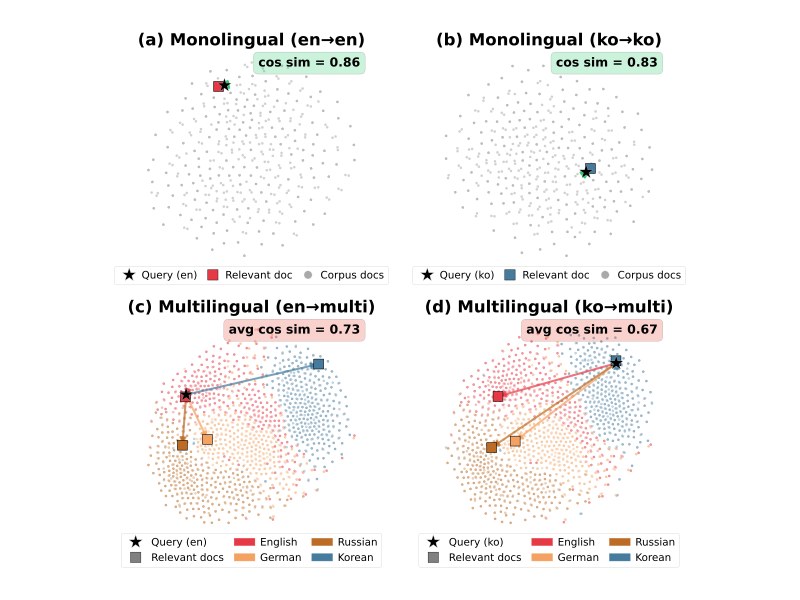
Multilingual Information Retrieval (MLIR) reflects real-world search environments in which queries and relevant documents may appear in different languages within a mixed-language corpus. However, existing embedding models are primarily optimized for Multi-Monolingual retrieval and their performance often degrades in MLIR settings. Moreover, directly applying conventional contrastive learning to MLIR can exacerbate language clustering and expose a trade-off between cross-lingual alignment and embedding uniformity. To address these limitations, we propose MIMO: Multilingual Information Retrieval via Monolingual Objectives, a two-stage framework that uses a stable English semantic space from a high-performing teacher model as an anchor. MIMO first initializes the student model's cross-lingual alignment through knowledge distillation, and then jointly optimizes distillation and cross-lingual contrastive learning to improve retrieval discrimination while preserving alignment. Extensive experiments show that MIMO consistently outperforms existing cross-lingual training baselines across various MLIR and Multi-Monolingual benchmarks. MIMO also remains competitive with off-the-shelf models of similar or larger parameter scales. Furthermore, our cross-lingual Alignment-Uniformity analysis clarifies the distinct roles of the two loss components and shows that their combination yields a favorable trade-off between alignment and uniformity.
Motivation
<!-- Replace the sentence below with your personal motivation for this work. -->Personal motivation for this work will be added here.
Notes
<!-- Optional: add contributions, behind-the-scenes notes, talks, code, or media links. -->BibTeX
@inproceedings{2026-mimo-multilingual-information-retrieval-monolingual-objectives,
  title = {MIMO: Multilingual Information Retrieval via Monolingual Objectives},
  author = {Youngjoon Jang and Seongtae Hong and Heuiseok Lim},
  booktitle = {Proceedings of the 2026 Conference on Empirical Methods in Natural Language Processing},
  year = {2026},
  month = {10},
  abstract = {Multilingual Information Retrieval (MLIR) reflects real-world search environments in which queries and relevant documents may appear in different languages within a mixed-language corpus. However, existing embedding models are primarily optimized for Multi-Monolingual retrieval and their performance often degrades in MLIR settings. Moreover, directly applying conventional contrastive learning to MLIR can exacerbate language clustering and expose a trade-off between cross-lingual alignment and embedding uniformity. To address these limitations, we propose MIMO: Multilingual Information Retrieval via Monolingual Objectives, a two-stage framework that uses a stable English semantic space from a high-performing teacher model as an anchor. MIMO first initializes the student model's cross-lingual alignment through knowledge distillation, and then jointly optimizes distillation and cross-lingual contrastive learning to improve retrieval discrimination while preserving alignment. Extensive experiments show that MIMO consistently outperforms existing cross-lingual training baselines across various MLIR and Multi-Monolingual benchmarks. MIMO also remains competitive with off-the-shelf models of similar or larger parameter scales. Furthermore, our cross-lingual Alignment-Uniformity analysis clarifies the distinct roles of the two loss components and shows that their combination yields a favorable trade-off between alignment and uniformity.},
  url = {https://arxiv.org/abs/2605.31171}
}