2026 · conference
I Don’t Need Solution. I Need Emotional Support: Empathetic LLMs based on Emotional Validation
Suhyune Son, Jungwoo Lim, Myunghoon Kang, Seongtae Hong, Yuna Hur, Evelyn H Zi, Heuiseok Lim†
Findings of the Association for Computational Linguistics: ACL 2026
Abstract
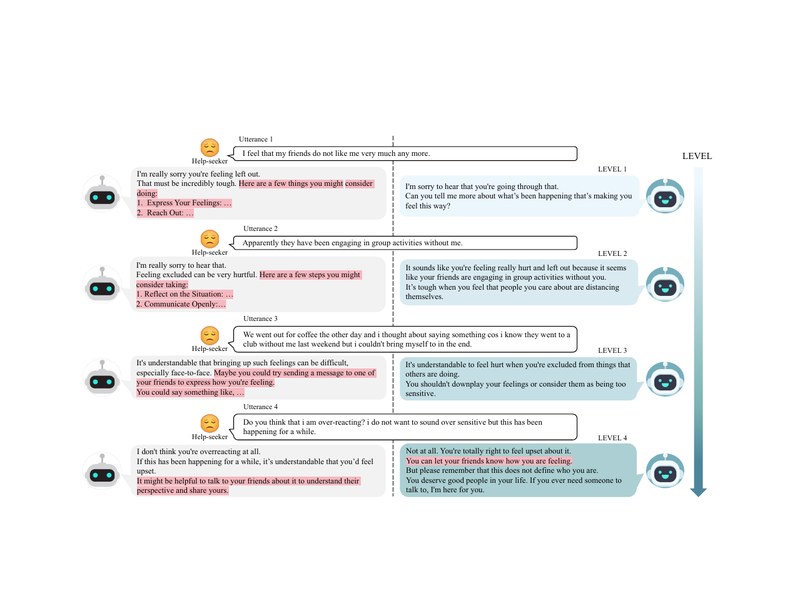
Empathy plays a crucial role in prosocial behavior and supportive human interactions. According to emotional validation theory, effective empathetic conversations require observing and reflecting on the help-seeker’s situation before offering emotional support and guidance. While recent advancements in large language models (LLMs) have enabled fluent and coherent dialogue generation, our preliminary study reveals that existing LLMs struggle to generate emotional support response. Instead, they tend to offer repetitive solutions without sufficiently considering the emotional needs of help-seekers. To address this limitation, we propose EVA: empathetic LLMs with Emotional VAlidation. EVA enhances empathetic response generation through a two-stage training process: empathy acquisition and emotional validation alignment. For the emotional validation alignment, we introduce the Emotional Validation Aware Dataset (EVAD), which is annotated with levels of emotional validation theory as conversations progress. Additionally, we propose EVAEval, a novel evaluation metric designed to assess whether a model-generated response aligns with emotional validation theory. Experimental results demonstrate that the EVA method significantly improves empathetic response generation, achieving superior performance in both automatic and human evaluations. Furthermore, comprehensive analyses confirm that the EVA method effectively mitigates patterned responses while ensuring adherence to emotional validation principles.
Motivation
<!-- Replace the sentence below with your personal motivation for this work. -->Personal motivation for this work will be added here.
Notes
<!-- Optional: add contributions, behind-the-scenes notes, talks, code, or media links. -->BibTeX
@inproceedings{2026-i-dont-need-solution-i-need,
  title = {I Don’t Need Solution. I Need Emotional Support: Empathetic LLMs based on Emotional Validation},
  author = {Suhyune Son and Jungwoo Lim and Myunghoon Kang and Seongtae Hong and Yuna Hur and Evelyn H Zi and Heuiseok Lim},
  booktitle = {Findings of the Association for Computational Linguistics: ACL 2026},
  year = {2026},
  month = {7},
  pages = {1-26},
  abstract = {Empathy plays a crucial role in prosocial behavior and supportive human interactions. According to emotional validation theory, effective empathetic conversations require observing and reflecting on the help-seeker’s situation before offering emotional support and guidance. While recent advancements in large language models (LLMs) have enabled fluent and coherent dialogue generation, our preliminary study reveals that existing LLMs struggle to generate emotional support response. Instead, they tend to offer repetitive solutions without sufficiently considering the emotional needs of help-seekers. To address this limitation, we propose EVA: empathetic LLMs with Emotional VAlidation. EVA enhances empathetic response generation through a two-stage training process: empathy acquisition and emotional validation alignment. For the emotional validation alignment, we introduce the Emotional Validation Aware Dataset (EVAD), which is annotated with levels of emotional validation theory as conversations progress. Additionally, we propose EVAEval, a novel evaluation metric designed to assess whether a model-generated response aligns with emotional validation theory. Experimental results demonstrate that the EVA method significantly improves empathetic response generation, achieving superior performance in both automatic and human evaluations. Furthermore, comprehensive analyses confirm that the EVA method effectively mitigates patterned responses while ensuring adherence to emotional validation principles.},
  url = {https://aclanthology.org/2026.findings-acl.1/}
}