2026 · conference
DART: Draft-Agreement Routing for Training-Free Adaptive Thinking Budgets in Hybrid Reasoning Models
Jungseob Lee, Seongtae Hong, Seungjun Lee, Jaehyung Seo, Junyoung Son, Sugyeong Eo, Chanjun Park, Hyeongju Park, Hyeonseok Moon, Heuiseok Lim†
Findings of the Association for Computational Linguistics: EMNLP 2026
Abstract
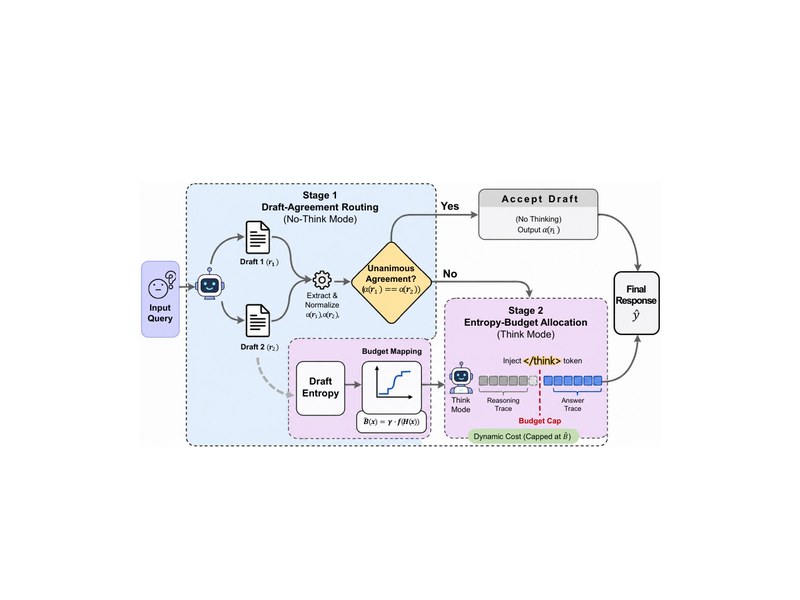
Hybrid reasoning models can answer directly or spend extra tokens on extended thinking. A practical router should choose between these modes for each query, so easy problems avoid unnecessary reasoning and hard problems receive enough budget to finish the answer. Existing routers move in this direction, but they typically require labeled training data or fix thinking budgets up front, ignoring answer-level evidence from the model itself. We introduce DART, a training-free routing framework that samples two cheap no-think drafts, accepts direct answering when the drafts agree, and predicts a thinking budget from draft entropy when they disagree. Across the main comparisons, DART preserves or improves always-thinking accuracy in most settings while reducing thinking-token use. On math reasoning, accuracy improves by up to 9.0 points on Olympiad-level problems while thinking tokens drop 15-69%. On code reasoning under execution-based equivalence, accuracy improves by up to +22.5 points while thinking tokens drop 51-63%. The Stage 1 signal extends across model scales (0.6B-32B), model families, and API-only hosted settings, with no labeled data and no gradient updates required.
Motivation
<!-- Replace the sentence below with your personal motivation for this work. -->Personal motivation for this work will be added here.
Notes
<!-- Optional: add contributions, behind-the-scenes notes, talks, code, or media links. -->BibTeX
@inproceedings{2026-dart-draft-agreement-routing-training-free,
  title = {DART: Draft-Agreement Routing for Training-Free Adaptive Thinking Budgets in Hybrid Reasoning Models},
  author = {Jungseob Lee and Seongtae Hong and Seungjun Lee and Jaehyung Seo and Junyoung Son and Sugyeong Eo and Chanjun Park and Hyeongju Park and Hyeonseok Moon and Heuiseok Lim},
  booktitle = {Findings of the Association for Computational Linguistics: EMNLP 2026},
  year = {2026},
  month = {10},
  abstract = {Hybrid reasoning models can answer directly or spend extra tokens on extended thinking. A practical router should choose between these modes for each query, so easy problems avoid unnecessary reasoning and hard problems receive enough budget to finish the answer. Existing routers move in this direction, but they typically require labeled training data or fix thinking budgets up front, ignoring answer-level evidence from the model itself. We introduce DART, a training-free routing framework that samples two cheap no-think drafts, accepts direct answering when the drafts agree, and predicts a thinking budget from draft entropy when they disagree. Across the main comparisons, DART preserves or improves always-thinking accuracy in most settings while reducing thinking-token use. On math reasoning, accuracy improves by up to 9.0 points on Olympiad-level problems while thinking tokens drop 15-69%. On code reasoning under execution-based equivalence, accuracy improves by up to +22.5 points while thinking tokens drop 51-63%. The Stage~1 signal extends across model scales (0.6B-32B), model families, and API-only hosted settings, with no labeled data and no gradient updates required.},
  url = {https://arxiv.org/abs/2606.23181}
}